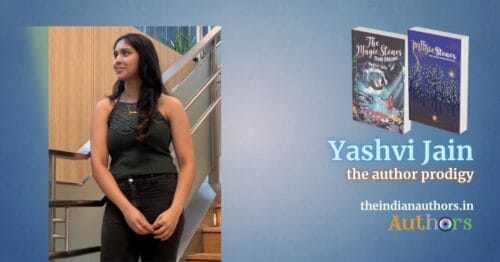
Yashvi Jain occupies an unusual place in contemporary children’s writing. She entered the literary world not after years of formal literary training, but as an exceptionally young reader who wanted stories of the kind she herself enjoyed. The urge for more stories, stories of the kind she enjoyed, led her to knock on the doors of fictional craft. She began writing The Magic Stones at about eleven, after developing an interest in mystery, fantasy, suspense and humour. The first volume, The Magic Stones: Dark Dreams, was published in 2021, followed by The Magic Stones: The Tower of Destruction in 2023. She is also reported to be working on a third instalment. The description that fits her best, “author prodigy,” is understandable. The young author’s distinction lies not simply in publishing at a young age. It lies in her early attempt to sustain a fictional universe, articulate a philosophy of children’s literature, and grow from one adventure into a larger mythology.
The beginnings of the writer are revealing. Jain has explained that her writing emerged from reading: she was attracted to particular kinds of fiction and, when she felt that the available books appealing to her were insufficient, she began imagining the stories she wanted to read herself. This indicates an active relationship between reader and text, in which books become forms that can be entered, questioned and recreated. The impulse is visible in The Magic Stones: Dark Dreams, whose opening places Flora Bennett and Rosy Kelly at a Halloween carnival before gradually transforming an ordinary childhood setting into a mystery and then a supernatural adventure.
Yashvi Jain’s literary identity is rooted in imaginative expansion. Her method is to begin with something recognisable and enlarge its possibilities. A carnival becomes the site of a mystery; a mysterious prankster leads the protagonists into hidden spaces; supernatural encounters introduce magic stones; and the apparently local adventure eventually points towards the Dark Dreams and a larger conflict. This architecture demonstrates an instinct valuable in children’s fantasy: making the extraordinary emerge from the familiar. The world changes around the protagonists, allowing curiosity to become the mechanism through which fantasy is discovered. This is a rare trait in the fictional craft of an author of such young age!
The same quality appears in the writer’s treatment of character. Flora investigates, questions, improvises and acts. Rosy functions as friend and counterpoint, while James adds another dimension to the mystery. Their interactions are frequently humorous, and the narrative allows fear, confusion, irritation and excitement to coexist. Recent critical discussion of Jain’s work notes that her characters often respond to danger with jokes, sarcasm and spontaneous observations. This gives the books a recognisably youthful register. The characters are not idealised miniature adults. They make decisions with incomplete information, misunderstand situations and respond emotionally. For a young readership, that accessibility is a significant part of the appeal.
Yashvi’s most interesting present statement concerns what she wants her fiction to do. She has indicated that she does not want her stories to rely on a simple division between heroes and villains. Instead, she wants readers to question moral categories, consider why characters behave as they do, and recognise that apparently straightforward situations may contain competing motives. The first volume does not yet realise that philosophy in totality. The prankster mystery eventually reveals a motive rather than presenting wrongdoing as inexplicable evil. In the subsequent volume, questions of trust, responsibility, power and sacrifice become more prominent. The fantasy world therefore becomes a setting in which young readers encounter ethical problems through action rather than direct moral instruction.
This is particularly relevant to Jain’s understanding of writing for children. Her preference is not to lecture young readers but to make them participate in the questions raised by the story. Children’s fiction can become didactic when moral conclusions are imposed upon the reader. Jain instead places protagonists in situations where they must decide whom to trust, whether to intervene, how to use their abilities and what responsibility accompanies power. The magic in her fiction is consequently more than spectacle. It becomes a narrative instrument for exploring agency. Flora’s powers create possibilities, but they also create risks and obligations.
The second volume is important in assessing her development. The Magic Stones: The Tower of Destruction expands the setting into Astrolen and introduces a broader conflict involving the Dark Dreams, Dolores, new abilities and the survival of an entire population. The magic stones acquire a more elaborate significance, while the protagonists learn more about their own powers and the rules of the world around them. This progression suggests that Yashvi Jain is beginning to understand a central demand of series fiction: imagination must eventually be supported by internal structure. A fantasy world cannot depend indefinitely on surprises. It needs rules, relationships, consequences and mythology capable of sustaining future narratives.
Yasvhi Jain’s writing style remains one of the clearest markers of her age and stage of development. Her prose is energetic, direct and conversational. The first-person narration keeps the reader close to Flora’s immediate thoughts, producing spontaneity and humour. The voice is often most effective when danger is interrupted by an unexpected comic observation, creating a tone likely to appeal to younger readers. At the same time, the writing can become crowded. Action, dialogue, description and internal reaction sometimes arrive in rapid succession, and some scenes would benefit from tighter sentence construction, greater restraint and more economical exposition. These are legitimate craft limitations, but they do not diminish the abundance of imagination already evident in her work.
That distinction is essential when discussing her as an author prodigy. Early publication is interesting, but literary promise depends on whether the young writer can continue learning. Jain’s record so far offers encouraging evidence because the second book expands rather than merely repeats the imaginative framework of the first. Her continued work on the series also suggests that she is not treating writing as a one-time childhood achievement. She appears to regard authorship as an ongoing practice.
There is also an intriguing dimension to the young writer’s present academic interests. Public profiles indicate that she is studying mathematics, physics and computer science alongside English Literature, with an interest in computer science and AI programming. There is a suggestive correspondence between systems thinking and her approach to fantasy, where powers, rules, objects and consequences must operate within an imagined structure. Whether technology and literature eventually intersect in her career remains open.
Another defining feature of Jain’s literary identity is her interest in readers who feel different. The dedication of The Magic Stones addresses readers who have “always wanted to be different”, a phrase that provides a useful interpretive key to her fiction. Her protagonists enter unfamiliar worlds, discover abilities they did not fully understand, and reconsider their identities. Difference is therefore connected with discovery rather than presented merely as isolation. The theme has particular resonance in children’s literature, where belonging and self-discovery are formative concerns.
An objective assessment must nevertheless remain balanced. Jain’s current achievement is considerable for her age, but age cannot substitute for literary craft. Her future development will depend on whether she can transform imaginative abundance into greater narrative control. She can strengthen character psychology, reduce repetition, refine dialogue, improve pacing and allow moral complexity to emerge more naturally from character and circumstance. Her stated interest in challenging simple categories of good and evil will become particularly compelling if future books give opposing characters deeper motivations rather than merely reversing conventional labels.
Yashvi Jain is therefore best understood not as a finished prodigy but as a young literary talent in formation. The phrase “author prodigy” captures the unusual precocity of her achievement, but the more important fact is what she does with that early beginning. She has moved from avid reader to published novelist, from a single fantasy adventure to a continuing fictional universe, and from imaginative spectacle towards questions of power, responsibility, identity and moral choice. Her present statements indicate that she is already thinking about writing as more than entertainment. She wants young readers to enjoy stories while also thinking through them.
That combination may ultimately prove the most significant aspect of her career. The Magic Stones began with the simple desire of a young reader to find more stories. It has since become an evolving literary project. Jain has the imagination to populate that project with unusual worlds and adventures; her next challenge is to acquire the discipline to shape those possibilities with increasing precision. If she continues to read widely, revise seriously and interrogate her assumptions as a writer, the distance between youthful promise and mature literary accomplishment can become especially productive.
Yashvi Jain’s story, therefore, is not simply about a child who wrote a book. It is about a young writer who began early enough to allow readers to watch the development of her craft. Her books provide evidence of imagination, ambition and a growing interest in the moral possibilities of children’s fantasy. Her statements reveal a writer already asking what stories should accomplish. The real measure of the prodigy will now lie in how consistently she can turn those ideas into increasingly assured literature. At present, the evidence suggests a promising beginning and, more importantly, a writer whose literary journey is still unfolding.
Amit for The Indian Authors