Chaman Nahal: History, Memory, and Moral Realism in Indian English Fiction
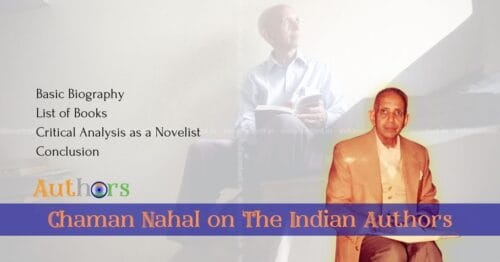
Chaman Nahal (1927–2013) occupies a significant, though sometimes understated, position within the canon of Indian English literature. Best known for his Partition novel Azadi (1975), Nahal’s literary career spans fiction, criticism, memoir, and editorial work. His oeuvre reflects the historical turbulence of twentieth-century India, particularly the rupture of Partition, the ambiguities of colonial modernity, and the ethical anxieties of nation-making.
Unlike writers who foreground either nationalist triumph or postcolonial disillusionment in overtly ideological registers, Nahal approaches history through the lens of lived experience. His fiction is marked by moral inquiry, psychological nuance, and a disciplined narrative realism. For students and researchers of Indian English literature, Chaman Nahal’s literary contributions should be an interesting study. Nahal represents an important bridge between the first generation of post-Independence novelists and the later globalised phase of Indian writing in English. In this article, we will later understand how Nahal achieved this feat through his writings.
This expanded critical biography examines Nahal’s life, literary development, stylistic features, and intellectual location within the broader horizon of Indian English literature. It also situates him comparatively alongside contemporaries such as Khushwant Singh, Bhisham Sahni, and Bapsi Sidhwa, and contextualises his work within critical discussions of Partition memory.
Life, Displacement, and Intellectual Formation
Chaman Lal Nahal was born in 1927 in Sialkot, in undivided Punjab. The geography of his childhood, cosmopolitan, multilingual, and communally interwoven, would later become the emotional and symbolic terrain of Azadi, perhaps his magnum opus. Partition in 1947 uprooted him, as it did millions of others, transforming him into a refugee in newly independent India. This experience of forced migration and civilisational rupture forms the emotional substratum of his fiction.
In his memoir, Silent Life: Memoirs of a Writer, Nahal reflects on his upbringing in a middle-class Hindu family, shaped by the influence of the Arya Samaj, nationalist currents, and the colonial administrative presence. The memoir does not adopt a sensational tone; rather, it presents a reflective and ethically alert consciousness. The “silent life” of the title signals introspection rather than withdrawal. Nahal perceives writing not as self-advertisement but as moral testimony.
After Partition, Nahal pursued higher education and eventually became an academic, serving as Professor and Head of the Department of English at the University of Delhi. His scholarly interests included D. H. Lawrence and Ernest Hemingway, as seen in works such as D. H. Lawrence: An Eastern View and The Narrative Pattern in Ernest Hemingway’s Fiction. These engagements profoundly shaped his narrative discipline. From Lawrence, he absorbed an interest in psychological depth and moral tension; from Hemingway, structural restraint and narrative economy.
Thus, Nahal’s literary sensibility was formed at the intersection of lived historical trauma and formal academic training. This dual inheritance distinguishes his fiction from both purely experiential accounts and purely theoretical constructs. The surroundings, the geography, the locality, the culture, the civilisation, the struggles of the masses… the things that Nahal observed around him found great reflection his fiction. In his words:
“Give the story a local colour, bring in local details, local history, local geography, but only to the extent they support and further the main theme.”
(Silent Life 58)
List of Works by Chaman Nahal
I. Novels
- The Weird Dance (1961)
- Into Another Dawn (1977)
- Azadi (1975)
- The English Queen (1979)
- The Crown and the Loincloth (1981)
- Sunrise in Fiji (1988)
II. Memoir
Silent Life: Memoirs of a Writer (2003)
III. Literary Criticism and Scholarly Works
- The Narrative Pattern in Ernest Hemingway’s Fiction (1963)
- D. H. Lawrence: An Eastern View (1971)
- A Conversation with J. Krishnamurti (1963)
IV. Edited Volume
Drugs and the Other Self (ed.) (1972)
Notes for Scholarly Use
- Azadi (1975) remains his most widely studied and internationally circulated work.
- The Crown and the Loincloth forms part of a broader historical and political engagement with colonial India.
- His critical writings reflect his academic career and intellectual engagement with Western modernism.
- Silent Life provides autobiographical insight into his literary philosophy and career trajectory.
Historical Witness: Azadi and the Representation of Partition
1. Narrative Architecture
Published in 1975, Azadi remains one of the most comprehensive fictional accounts of Partition from the perspective of the urban Hindu middle class in Punjab. The novel is divided into three sections: “The Lull,” “The Storm,” and “The Aftermath”. This structural design mirrors the progression from normalcy to catastrophe to dislocation.
The opening chapters establish a textured social world in Sialkot. Lala Kanshi Ram, a grain merchant, embodies the contradictions of colonial subjectivity. He admires British discipline and pageantry even as he resents imperial domination. Early in the novel, he reads the Urdu newspaper each morning with solemn authority, absorbing news of Gandhi, atom bombs, and the British Raj (Nahal, Azadi 13–18). This daily ritual symbolises the mediated consciousness of colonial India, signalling at global events filtered through local interpretation.
2. Colonial Ambivalence
Lala Kanshi Ram’s attitude toward the British is complex. He condemns them as exploiters yet reveres their efficiency and order. This ambivalence reflects what postcolonial theorists describe as the colonised subject’s divided psyche. However, Nahal does not reduce this condition to a theoretical abstraction. Instead, he dramatises it through everyday gestures, such as attendance at parades, fascination with uniforms, anxiety about status, and symbolic proximity to authority.
“He hated them for what they had done to his country and wanted azadi.”
“But deeper down, he also admired the British — in any case he enjoyed the safety of the British Raj and hugged it lovingly.”
(Azadi 16)
In contrast to overtly nationalist fiction, Azadi presents colonial rule as simultaneously oppressive and stabilising. The novel implicitly questions whether the abrupt withdrawal of imperial authority precipitated the collapse of fragile communal harmony. Nahal raises grave questions in his narrative that touch on the theme of colonialism in a way that the literature of his peers and intellectual ancestors could seldom address.
3. Communal Fracture and Ethical Collapse
As the narrative moves into “The Storm,” communal tensions intensify. Nahal’s treatment of violence is controlled and restrained. He avoids graphic sensationalism. Instead, he foregrounds fear, rumour, betrayal, and the gradual erosion of trust. The violence is not merely physical; it is civilisational.
“It was not merely a question of losing property; it was a question of losing one’s place in the world.”
Unlike Saadat Hasan Manto, whose short stories expose the raw brutality and sexual violence of Partition with stark immediacy, Nahal’s approach is panoramic and socially embedded. The focus remains on family, property, displacement, and psychological disintegration. The migration sequences depicting trains crowded with refugees, abandoned homes, and fragile caravans emphasise loss rather than spectacle.
4. The Irony of Freedom
The title Azadi is deeply ironic. Political independence arrives simultaneously with dispossession. Freedom is experienced as exile. This irony places Nahal within a tradition of Partition writing that interrogates nationalist triumphalism. As Urvashi Butalia observes in The Other Side of Silence, independence and Partition were inseparable processes; freedom was born in violence (Butalia). Nahal’s fiction dramatises this historical paradox without rhetorical exaggeration.
Writing Style: Moral Realism and Controlled Irony
A sustained critical examination of Nahal’s style reveals several distinctive features. Some significant observations are below:
1. Classical Realism
Nahal adheres to linear narrative progression. Unlike later Indian English novelists such as Salman Rushdie, whose Midnight’s Children employs magical realism and narrative fragmentation, Nahal remains committed to structured realism. Events unfold chronologically. The narrative voice maintains clarity and authority.
This realism is not naïve; it is ethical. Nahal believes that historical trauma must be rendered intelligible through coherent storytelling.
2. Psychological Depth without Excess
While the narrative canvas is broad, Nahal frequently internalises experience through focal characters. Lala Kanshi Ram’s vanity, insecurity, communal anxiety, and pride are rendered with quiet irony. Nahal neither glorifies nor mocks him. The irony is gentle, almost compassionate.
3. Linguistic Plurality
Azadi foregrounds the coexistence of Punjabi, Urdu, Hindi, and English. This multilingual environment reflects the composite culture of pre-Partition Punjab. The language politics in the novel anticipate the fragmentation that Partition would intensify.
4. Controlled Satire
Nahal occasionally employs satire—particularly in scenes depicting Lala Kanshi Ram’s fascination with British authority. However, the satire never devolves into caricature. It serves to expose the fragility of colonial self-fashioning.
5. Narrative Restraint
Perhaps the most defining feature of Nahal’s style is restraint. He avoids melodrama even when describing atrocity. This restraint enhances emotional power. The reader is invited to reflect rather than react impulsively.
Comparison with Contemporaries
1. Nahal and Khushwant Singh
Khushwant Singh’s Train to Pakistan (1956) presents Partition through a tightly structured narrative centred on the village of Mano Majra. Singh’s prose is direct and often ironic; he foregrounds sexual tension and sudden violence. His focus is on the immediacy of catastrophe.
Nahal, by contrast, constructs a more expansive social tapestry. While Singh’s narrative is intense and compact, Nahal’s is gradual and panoramic. Singh compresses; Nahal accumulates. Singh emphasises sudden rupture; Nahal charts progressive disintegration.
2. Nahal and Bhisham Sahni
Bhisham Sahni’s Tamas (1974) examines the political manipulation behind communal riots. Sahni’s orientation is overtly political, emphasising structural causes.
Nahal’s emphasis is more domestic and psychological. He is less concerned with exposing political conspiracy and more with portraying moral bewilderment. Where Sahni diagnoses systemic pathology, Nahal observes civilisational confusion.
3. Nahal and Bapsi Sidhwa
Bapsi Sidhwa’s Ice-Candy-Man (1988) narrates Partition through a child’s perspective, employing memory and trauma as structuring devices. Sidhwa foregrounds gendered violence.
Nahal’s perspective remains largely male and middle-class. His treatment of women’s suffering is sympathetic but not centralised in the same manner as Sidhwa’s. However, both writers emphasise inter-communal relationships ruptured by history.
4. Nahal and Later Postcolonial Novelists
In the broader arc of Indian English literature, Nahal belongs to the generation between R. K. Narayan and the postmodern globalised novelists such as Rushdie and Arundhati Roy. Unlike Narayan, whose fiction is largely apolitical and regionally contained, Nahal engages directly with the national crisis. Unlike Rushdie, he avoids mythic allegory and linguistic exuberance.
In this sense, Nahal represents a transitional realist tradition—historically grounded, morally engaged, and formally disciplined.
Intellectual Location within Indian English Literature
M. K. Naik, in A History of Indian English Literature, identifies the post-Independence period as marked by historical engagement and social realism (Naik). Nahal’s work exemplifies this tendency. He neither retreats into regional idyll nor adopts experimental fragmentation.
Arvind Krishna Mehrotra’s A Concise History of Indian Literature in English notes the centrality of Partition as a defining moment in postcolonial consciousness (Mehrotra). Within this framework, Nahal’s Azadi stands alongside canonical Partition texts, though it has sometimes received less international attention.
Nahal’s relative marginality in global literary markets may be attributed to several factors:
- His adherence to realism rather than stylistic innovation.
- His focus on domestic social detail rather than diasporic spectacle.
- His refusal to exoticise violence.
Yet, within academic discourse in India, Azadi remains widely prescribed and critically respected.
The Memoir as Self-Interpretation: Silent Life
Chaman Nahal’s Silent Life: Memoirs of a Writer is not a self-congratulatory autobiography but a reflective meditation on the vocation of writing. The title itself signals restraint. Unlike contemporary assumptions and many instances of self-assumed honours, Chaman Nahal appropriately presents the writer not as a public celebrity but as a disciplined craftsman who must cultivate solitude, patience, and moral seriousness. For him, writing is neither mystical inspiration nor political slogan; it is sustained labour. He emphasises routine, rising early, revising rigorously, and distrusting intoxicated or emotionally excessive creativity. The memoir repeatedly underscores that artistic integrity depends on discipline rather than dramatic self-fashioning.
Nahal’s reflections on publishing further reveal his practical realism. He advises writers to retain rights, read contracts carefully, and avoid passivity while waiting for recognition. This pragmatic orientation demystifies authorship. The writer’s life, in his view, involves negotiation with institutions as much as engagement with imagination. Yet he remains modest about literature’s power. A writer may not change history, he suggests, but may influence individual hearts. This tempered belief reflects his broader moral humanism.
Stylistically, Silent Life mirrors the qualities found in Azadi: clarity, restraint, and reflective irony. The prose is lucid and unadorned, avoiding rhetorical flamboyance. Anecdotes are presented without sensationalism, even when dealing with personal loss or professional frustration. Emotional intensity is moderated through composure. The memoir thus becomes a document of ethical self-scrutiny. Nahal emerges as a writer who values craft over glamour, endurance over acclaim, and moral responsibility over literary spectacle.
The memoir also illuminates his engagement with Western literary theory. His training in narrative structure is evident in the architectural precision of Azadi. The integration of scholarship and storytelling strengthens his credibility as both critic and creator.
Moral Humanism and Civilisational Anxiety
A unifying thread across Nahal’s works is moral humanism. Despite communal breakdown, he refuses to portray any community as inherently villainous. Characters such as Chaudhri Barkat Ali demonstrate interfaith loyalty. Betrayal arises not from essentialised hatred but from historical panic.
This humanism distinguishes Nahal from polemical narratives. He refuses to become a cynic, still holding tight to his beliefs in humanity. His writing affirms the fragility of civilisation and the necessity of ethical vigilance.
Limitations and Critical Observations
No critical biography would be complete without acknowledging limitations.
- Gender Perspective: Compared to later feminist Partition narratives, Nahal’s portrayal of women is less centralised. However, this criticism of a novel that focuses on social issues as a whole might seem exaggerated.
- Formal Conservatism: His commitment to realism may appear stylistically conservative in the context of postmodern innovation.
- Middle-Class Focus: His emphasis on the urban Hindu middle class may limit representational breadth.
However, these limitations must be contextualised historically. Nahal wrote before the globalisation of Indian English fiction and before the dominance of postmodern experimentation.
Legacy and Continuing Relevance
Chaman Nahal’s legacy rests primarily on Azadi, yet his broader contributions as scholar and memoirist deserve equal recognition. For students of Indian English literature, his work provides:
- A model of historically grounded realism.
- A nuanced portrayal of colonial ambivalence.
- An ethical framework for understanding Partition.
In contemporary times, when communal tensions resurface in public discourse, Azadi remains disturbingly relevant. It reminds readers that political decisions can fracture ordinary lives beyond repair.
Conclusion
Chaman Nahal stands as a chronicler of transition between colony and nation, harmony and violence, certainty and dislocation. His fiction embodies what may be termed moral realism: a disciplined narrative mode committed to historical accuracy, psychological complexity, and ethical reflection.
Situated between the early regional realism of R. K. Narayan and the postmodern exuberance of Salman Rushdie, Nahal represents a crucial phase in the evolution of Indian English literature. His contribution lies not in stylistic flamboyance but in historical conscience.
For scholars and researchers, Nahal offers a case study in how literature negotiates trauma without surrendering to sensationalism. By rendering Partition as a lived catastrophe rather than an abstract statistic, he ensures that memory remains human.
Professor of English Literature at Nava Nalanda Mahavihara
Founder of English Literature Education
Works Cited
Butalia, Urvashi. The Other Side of Silence: Voices from the Partition of India. Penguin, 1998.
Mehrotra, Arvind Krishna, editor. A Concise History of Indian Literature in English. Permanent Black, 2008.
Naik, M. K. A History of Indian English Literature. Sahitya Akademi, 1982.
Nahal, Chaman. Azadi. Houghton Mifflin, 1975.
—. Silent Life: Memoirs of a Writer. Rupa Publications, 2003.
Sahni, Bhisham. Tamas. Rajkamal Prakashan, 1974.
Singh, Khushwant. Train to Pakistan. Chatto & Windus, 1956.
Sidhwa, Bapsi. Ice-Candy-Man. Heinemann, 1988.