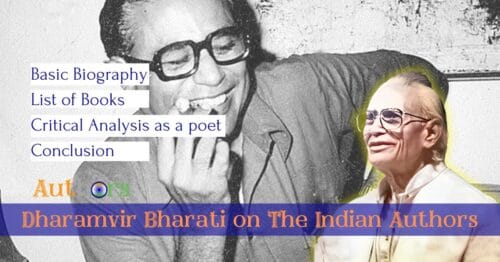
At times, the worst curse on a person becomes the thing best known about him! Dharamvir Bharati fits as the best subject if we consider his most famous work, “Gunahon ka Devta”, in light of the above assertion. The Hindi novel published in 1949 became synonymous with Dharamvir Bharati… and eventually it became his nemesis as well. Readers who have a casual relationship with literature, fragmented, ephemeral and ultimately sedimented after their chance encounter with the popular works they notice in some Instagram reel or get to know by many other means other than their active engagement with literature… often know Dharamvir Bharati as the author of Gunahon ka Devta… and that’s pretty much it. However, this legendary author was more than a one-book wonder, as many Booker-winning authors from India are. In this article, Amit Mishra, a senior editor and co-founder of The Indian Authors platform, writes in detail about Dharamvir Bharati.
Name: Dr Dharamvir Bharati
Birth: 25 December 1926, Prayagraj
Death: 4 September 1997, Mumbai
Famous Books: Gunahon ka Devta, Suraj ka Satvan Ghoda, Andha Yug
Genres: Literary Fiction, Psychological Fiction, Poetry, Criticism
Awards: Padma Shri (1972), Sangeet Natak Akademi Award for Playwriting, Bharat Bharati Samman, Vyas Samman
Style: Existentialism, Romanticism, Using Mythology to Explore Contemporary Realism
Few writers in modern Hindi literature have enjoyed the enduring popularity of Dharamvir Bharati, yet his significance extends far beyond the sentimental appeal that often defines his public reputation. A novelist, poet, playwright, essayist, and one of the most influential editors in Hindi journalism, Bharati occupied a distinctive space between literary idealism and modern psychological inquiry. Unlike Premchand, whose fiction is firmly anchored in social realism and agrarian life, Bharati turned inward to explore the emotional and moral turbulence of educated, urban India. Unlike Agyeya, whose intellectual modernism frequently borders on abstraction and philosophical detachment, Bharati remained emotionally accessible, allowing love, longing, guilt, sacrifice, and spiritual conflict to retain their immediacy without sacrificing literary sophistication. Nor does he share the sharp political radicalism or existential bleakness that characterises writers such as Mohan Rakesh or Nirmal Verma. His finest works, especially Gunahon Ka Devta, Andha Yug, and Kanupriya, reveal an uncommon ability to reinterpret myth, history, and intimate human relationships through lyrical prose, symbolic structures, and psychological nuance. His language is elegant without becoming ornamental, philosophical without becoming obscure, and poetic without abandoning narrative clarity. Yet Bharati is not without limitations. His idealisation of love occasionally verges on romantic excess, his female characters, despite their emotional depth, sometimes remain confined within moral or symbolic frameworks, and his reluctance to engage directly with class conflict, caste realities, or the harsher material conditions of post-Independence India distinguishes him from the more socially interventionist traditions represented by Premchand, Phanishwar Nath Renu, or Yashpal. Even so, Bharati’s enduring achievement lies in his remarkable capacity to illuminate the ethical and emotional crises of modern existence through a synthesis of mythology, romance, introspection, and cultural memory, securing his place as one of the most compelling and stylistically distinctive voices in twentieth-century Hindi literature.
In this detailed article, we will explore various facets of Dharamvir Bharati as a versatile author and a significant landmark in Hindi literature.
Biographical Details:
To understand Dharamvir Bharati merely through the lens of his celebrated novels or plays is to overlook the formative experiences that gave his writing its unusual emotional and intellectual texture. He belonged to Allahabad, a city that, during the middle decades of the twentieth century, functioned as one of the most vibrant centres of Hindi literary culture. Born into a middle-class Kayastha family, Bharati experienced financial insecurity after the untimely death of his father, Chiranji Lal, an event that profoundly shaped his emotional and moral imagination. His mother, Chanda Devi, assumed the responsibility of holding the family together under difficult circumstances, while his elder sister, Dr Veerbala, later emerged as an accomplished academic in her own right. These early experiences of bereavement, responsibility, and restrained aspiration recur, often transfigured rather than reproduced, in Bharati’s fiction, where characters are less driven by external action than by the burdens of conscience, memory, and emotional obligation. He pursued higher studies at the University of Allahabad, excelling in Hindi and receiving the Chintamani Ghosh Award for securing the highest marks in the subject. His doctoral research under the eminent linguist and scholar Dr Dhirendra Verma focused on Siddha Sahitya, revealing an engagement with medieval literary traditions that would later inform his remarkable ability to fuse classical consciousness with modern sensibility. Before achieving literary prominence, Bharati worked with literary journals such as Abhyudaya and Sangam, experiences that immersed him in the vigorous debates surrounding the evolving identity of modern Hindi literature and acquainted him with many of its leading intellectuals.
Bharati’s personal life has often attracted speculative commentary, particularly because Gunahon Ka Devta possesses such emotional authenticity that readers have been tempted to read it as disguised autobiography. Responsible literary criticism, however, demands caution. While it is reasonable to acknowledge that his understanding of love, separation, and emotional restraint was deeply personal, there is no conclusive documentary evidence establishing that the novel reproduces any specific romantic relationship from his own life. Such assumptions remain part of literary folklore rather than verified biography. What is historically established is that Bharati first married Kanta Bharati in 1954, and the couple had a daughter before the marriage eventually ended. He later married the noted Hindi writer Pushpa Bharati, with whom he shared a long intellectual companionship and raised two children. Those who knew him frequently described him as disciplined, reflective, and deeply committed to literature rather than literary celebrity, qualities that became even more evident after his move to Bombay as the editor of Dharmayug. Yet his transition into writing had begun much earlier, not as an act of professional ambition but as a natural extension of an intensely literary education and an inwardly restless temperament. The university classroom sharpened his critical faculties, editorial work exposed him to the pulse of contemporary Hindi letters, and personal experiences lent emotional credibility to his imagination. The result was a writer who neither retreated into academic erudition nor surrendered to popular sentimentality, but fashioned a body of work in which scholarship, lyricism, psychological insight, and ethical inquiry found an unusually harmonious balance.
Bharati’s Contribution to Hindi Literature:
Dharamvir Bharati’s contribution to Hindi literature cannot be measured merely by the enduring popularity of Gunahon Ka Devta or the canonical status of Andha Yug. His true achievement lies in expanding both the thematic and formal possibilities of post-Independence Hindi writing. At a time when Hindi literature was negotiating the competing impulses of Progressivism, Experimentalism, and the Nai Kahani movement, Bharati refused to remain confined within any single ideological framework. Instead, he cultivated a literary vision that combined psychological realism, philosophical reflection, lyrical expression, and cultural memory. His novels shifted the focus from external social structures to the intricate moral and emotional landscapes of the individual without abandoning broader ethical concerns. Gunahon Ka Devta transformed the Hindi psychological novel by presenting love not as sentimental fulfilment but as a complex interplay of desire, sacrifice, guilt, and self-restraint, while Suraj Ka Satvan Ghoda introduced an innovative narrative architecture that questioned the very nature of storytelling through multiple perspectives and layered narration. Equally significant was Andha Yug, a landmark in modern Indian theatre that reimagined the aftermath of the Mahabharata as a profound meditation on war, violence, political degeneration, and civilisational collapse. By relocating ancient myth within the moral anxieties of the twentieth century, Bharati demonstrated that mythology was not a repository of frozen legends but a living intellectual resource capable of interrogating contemporary history. His poetry, especially Kanupriya, similarly departed from devotional convention by presenting Radha as a psychologically autonomous consciousness whose voice interrogates love, separation, identity, and spiritual fulfilment with remarkable philosophical subtlety. Collectively, these works established Bharati as one of the foremost architects of modern Hindi literary sensibility, capable of uniting classical inheritance with contemporary existential concerns.
Bharati’s influence, however, extends beyond his creative oeuvre into the institutional and cultural evolution of Hindi literature. His long stewardship of Dharmayug fundamentally altered the landscape of Hindi literary journalism by transforming a weekly magazine into a national platform where literature, criticism, social commentary, history, science, arts, and public discourse could coexist without compromising intellectual standards. Under his editorship, Dharmayug reached an unprecedented readership and played a decisive role in introducing emerging writers, encouraging literary debate, and bridging the widening divide between serious literature and the expanding middle-class reading public. Unlike many editors who merely curated literary production, Bharati shaped reading habits and helped define the cultural imagination of post-Independence Hindi society. His essays and reportage further demonstrated that literary language could illuminate contemporary events without sacrificing aesthetic refinement or ethical seriousness. Even his war reporting retained the reflective depth of a humanist rather than the triumphalism of political rhetoric. Bharati’s legacy also resides in his stylistic synthesis. He combined the lyrical grace of the Chhayavad tradition with the psychological introspection of modern fiction and the symbolic density of classical Indian thought, producing a prose that remained accessible without becoming simplistic and philosophical without lapsing into abstraction. Although later critics have observed that his fiction is less attentive to caste, labour, and structural inequalities than that of writers such as Premchand, Yashpal, or Phanishwar Nath Renu, this limitation scarcely diminishes his stature. His enduring contribution lies in restoring ethical inquiry, emotional complexity, and mythic imagination to the centre of modern Hindi literature while simultaneously shaping the institutions through which that literature reached generations of readers, scholars, and theatre practitioners.
The Style of Dharamvir Bharati’s Writing:
Dharamvir Bharati’s literary style is best understood not as the continuation of a single tradition but as the confluence of several seemingly divergent streams of Hindi literature. He inherited the lyrical sensitivity of Chhayavad, absorbed the introspective temper of modernism, and employed the symbolic density of India’s mythological and cultural traditions without allowing any one influence to dominate his creative vision. Consequently, his writing resists convenient classification. While his contemporaries often aligned themselves with clearly identifiable literary movements, Bharati remained remarkably independent. His prose possesses the cadence of poetry, yet never loses narrative discipline; his poetry is philosophical without descending into abstraction; and his drama derives its power less from theatrical spectacle than from moral and psychological conflict. The editorial assessment in Dharamvir Bharati Granthavali rightly observes that his prose is distinguished by “rhythmicity, suggestiveness and symbolism”, noting that even in prose Bharati’s poetic sensibility produces an emotional intensity that transforms ordinary events into experiences of universal significance. Unlike Agyeya, whose intellectualism often demands strenuous interpretative effort from the reader, Bharati’s language remains lucid despite its philosophical depth. Unlike Jainendra Kumar, whose psychological analysis frequently narrows into individual consciousness, Bharati consistently situates personal dilemmas within larger civilisational, ethical, and cultural frameworks. His sentences flow with deceptive simplicity, carrying beneath their lyrical surface an intricate network of metaphors, archetypes, and moral inquiry. This rare synthesis explains why his works continue to appeal simultaneously to general readers, scholars, and theatre practitioners.
Perhaps the most distinctive feature of Bharati’s style is his ability to transform mythology into a living intellectual discourse rather than a repository of inherited legends. In his hands, myth ceases to function merely as narrative material and becomes an interpretative framework through which contemporary crises acquire historical and philosophical depth. Andha Yug remains the finest example of this technique. The Mahabharata is neither retold nor modernised superficially. Instead, its aftermath becomes an allegory of war, political degeneration, collective guilt, and moral blindness in the twentieth century. The same stylistic principle governs Kanupriya, where Radha emerges not as the devotional heroine of medieval Bhakti poetry but as an autonomous philosophical consciousness questioning love, absence, destiny, and transcendence. Bharati’s symbolism therefore differs fundamentally from ornamental symbolism. Every recurring image, whether darkness, silence, ash, river, forest, or battlefield, performs an ethical function within the text. His symbols illuminate psychological and civilisational anxieties simultaneously. Critics have frequently noted that Bharati’s writing combines emotional immediacy with reflective distance, allowing readers to experience intense feeling without surrendering to sentimentality. Chandrakant Bandivadekar similarly remarks that Bharati’s literary personality is marked by an unusual synthesis of cultural rootedness, humanism, nationalism, philosophical contemplation, and deep emotional responsiveness, qualities that repeatedly surface across his fiction, poetry, essays, and dramatic writing. This fusion of symbolic imagination with ethical inquiry distinguishes Bharati from many of his contemporaries whose experiments remained either predominantly formal or overtly ideological.
Equally remarkable is Bharati’s stylistic command over emotional and psychological expression. Few modern Hindi writers have depicted the interior life with comparable restraint and dignity. His characters rarely announce their suffering through dramatic outbursts. Instead, emotional conflict unfolds through silence, memory, hesitation, and moral introspection. Love in Bharati’s fiction is seldom an end in itself. It becomes a medium through which questions of duty, renunciation, identity, and spiritual fulfilment are examined. This explains why Gunahon Ka Devta continues to resonate across generations despite changing literary fashions. Bharati also possessed an extraordinary sensitivity to rhythm and imagery. His prose frequently approaches the condition of verse through carefully balanced phrases, recurring motifs, and musical cadence, yet it never compromises clarity or narrative progression. The stylistic elegance of his language enabled him to move effortlessly between fiction, drama, essays, reportage, and literary journalism, preserving a recognisable authorial voice across genres. At the same time, a critical evaluation must acknowledge that his aesthetic preferences occasionally limit his social vision. Compared with Premchand, Yashpal, or Phanishwar Nath Renu, Bharati displays relatively less engagement with structural questions of caste, labour, and economic inequality. His imagination is drawn more consistently towards ethical, psychological, and cultural crises than towards material conflict. Nevertheless, this limitation scarcely diminishes his literary stature because his central concern lies elsewhere. His enduring achievement is the creation of a language capable of harmonising lyricism with intellect, myth with modernity, and individual consciousness with civilisational memory. As the editor of Dharamvir Bharati Granthavali observes, the emotional vitality of Bharati’s writing springs from an inner cultural consciousness that continuously enlarges private experience into a shared human and national inheritance.
Bharati: The Prose Writer
Dharamvir Bharati’s stature as a prose writer is often overshadowed by the immense popularity of Gunahon Ka Devta and Andha Yug, yet the present volume of the Dharamvir Bharati Granthavali demonstrates that his prose constitutes an equally significant achievement in modern Hindi literature. The editorial introduction characterises his prose as possessing an uncommon combination of “लयबद्धता, चित्रमयता और प्रतीकात्मकता”, observing that Bharati’s poetic sensibility survives intact even in his essays and memoirs, endowing ordinary events with emotional resonance and philosophical depth. Unlike many essayists who merely document experiences, Bharati transforms lived reality into reflective literature. His prose does not advance arguments mechanically. It moves associatively through memory, history, landscape, mythology, and personal encounter, allowing one image to illuminate another until a broader cultural vision emerges. The essays collected in शब्दिता, discussed extensively in this volume, reveal what the editor describes as Bharati’s transparent, candid, and deeply humane literary personality. Particularly memorable are his affectionate portraits of literary contemporaries such as Mahadevi Verma, Amritlal Nagar, Hazari Prasad Dwivedi, Harivansh Rai Bachchan, and V. V. Shirwadkar, where admiration never degenerates into hagiography but is balanced by critical insight and intimate observation. Equally revealing is his prose on Indian civilisation, where he argues that India’s cultural vitality rests not upon political rhetoric but upon its civilisational memory, pluralistic traditions, and moral imagination. Reflecting on the country’s future after the Emergency, he poses the searching question, “देखें इस चुनाव मोड़ पर आप कौन-सा रास्ता चुनते हैं?”, a question that is simultaneously political, ethical, and civilisational. Elsewhere, meditating on culture itself, he remarks:
“इसलिए कि कम्प्यूटर कोई संस्कृति नहीं दे पाया। उसने संगठन दिया, गति दी, आंदोलन दिए, शक्ति-परिणाम दिए लेकिन संस्कृति के लिए उसके पास कोई संस्कृति नहीं थी”
It reminds us that technological progress cannot substitute for historical consciousness and moral inheritance. These reflections illustrate Bharati’s distinctive prose method. He seldom separates literature from life or aesthetics from ethics. Instead, he composes prose that is lyrical without ornamentation, intellectually demanding without obscurity, and profoundly rooted in Indian cultural experience while remaining alert to the anxieties of the modern world. Such writing explains why Bharati occupies a unique position in Hindi prose, standing somewhere between the civilisational scholarship of Hazari Prasad Dwivedi and the psychological introspection of Agyeya, yet remaining unmistakably and inimitably himself.
List of Works by Dharamvir Bharati:
Novels
- Gunahon Ka Devta (1949)
- Suraj Ka Satvan Ghoda (1952)
- Gyarah Sapno Ka Desh (1960)
- Prarambh Va Samapan (1969)
Verse Drama
- Andha Yug (1953)
Poetry
- Thanda Loha (1952)
- Saat Geet Varsh (1959)
- Kanupriya (1961)
- Sapna Abhi Bhi (1993)
- Adyant (1993)
- Meri Vani Gairik Vasana (1994)
- Kuchh Lambi Kavitayen (1994, collected edition)
- Toota Pahiya (published as an individual long poem and later included in collected editions)
Short Story Collections
- Murdon Ka Gaon (1946)
- Swarg Aur Prithvi (1949)
- Chand Aur Toote Hue Log (1955)
- Band Gali Ka Aakhiri Makaan (1960)
- Saas Ki Kalam Se (1990)
- Samast Kahaniyan (Collected Stories, 1994)
Essays, Memoirs and Prose
- Thele Par Himalaya (1958)
- Pashyanti (1969)
- Nadi Pyasi Thi (1972)
- Neel Jheel (1975)
- Shabdita (1997)
- Kahani-Ankahani (1997)
- Yuddh Yatra (1972, war reportage)
- Thanda Loha Tatha Anya Nibandh (collected prose edition)
Literary Criticism and Literary Thought
- Pragativad: Ek Samiksha (1949)
- Manav Mulya Aur Sahitya (1960)
- Sahitya Vichar Aur Smriti (collected critical essays, later edition)
- Sahitya Vimarsh (collected critical writings, later edition)
Research
1. Siddha Sahitya (Doctoral Research; first published as a book in the early 1960s)
Critics on Bharati – A Summarised Version of the Paradoxical Reception
The critical reception of Dharamvir Bharati reveals an intriguing paradox in modern Hindi literary history. Few writers have been as universally admired by readers while simultaneously provoking such divergent responses from literary critics. His admirers regard him as one of the principal architects of post-Independence Hindi literature who successfully reconciled lyricism with intellectual inquiry, mythology with modern consciousness, and emotional intimacy with philosophical reflection. Theatre scholars almost unanimously identify Andha Yug as a watershed in Indian drama, arguing that it liberated myth from devotional convention and transformed it into an instrument for interrogating violence, political degeneration, and the ethical aftermath of Partition. The play has been described as inaugurating a new phase in Hindi theatre, a judgement reinforced by its celebrated productions under Satyadev Dubey, Ebrahim Alkazi, M. K. Raina, Ratan Thiyam, and several other directors. Similarly, Gunahon Ka Devta has acquired an almost unparalleled status among generations of readers, many of whom regard it as the definitive psychological novel of youthful love in Hindi literature. Critics have repeatedly praised Bharati’s remarkable command over language, observing that his prose achieves a rare synthesis of poetic cadence, psychological precision, and philosophical suggestiveness without sacrificing readability. Chandrakant Bandivadekar, in the editorial introduction to the Dharamvir Bharati Granthavali, argues that Bharati’s distinctive contribution lies in his ability to integrate cultural nationalism, historical consciousness, humanism, aesthetic refinement, and emotional authenticity into a unified literary vision. He further emphasises that Bharati’s prose possesses an unusual rhythmic quality, symbolic richness, and transparency that enable personal experience to expand naturally into collective cultural memory. Such assessments explain why Bharati continues to occupy a singular position between the classical inheritance of Hazari Prasad Dwivedi and the psychological modernism of Agyeya, while remaining resistant to neat ideological classification.
Yet Bharati’s reputation has never remained beyond critical scrutiny. Marxist critics, particularly those working within the tradition influenced by Ramvilas Sharma, have frequently argued that Bharati privileges ethical and emotional crises over material social contradictions, thereby leaving questions of class struggle, labour, and economic exploitation relatively underexplored. Later critics associated with Dalit and feminist discourse have extended this criticism by observing that his literary universe rarely engages systematically with caste hierarchies or structural inequalities, despite his profound concern for human suffering. His female characters, though psychologically complex and emotionally compelling, are often interpreted as embodiments of moral idealism rather than autonomous agents capable of radically challenging patriarchal structures. Even Gunahon Ka Devta, despite its extraordinary psychological depth, has been criticised for idealising renunciation and emotional sacrifice to an extent that occasionally obscures the social realities governing gender relations. Some modernists likewise found Bharati’s persistent reliance on myth, spirituality, and civilisational symbolism insufficiently radical when compared with the existential experimentation of Nirmal Verma or the formal innovations of Mohan Rakesh. Nevertheless, these reservations have seldom diminished his canonical stature because they concern the limits of his chosen literary vision rather than deficiencies of artistic execution. Even critics who question his ideological orientation generally acknowledge the exceptional craftsmanship of his language, the subtlety of his psychological insight, and the enduring power of works such as Andha Yug, Kanupriya, and Suraj Ka Satvan Ghoda. The broad consensus in contemporary scholarship is that Bharati’s lasting importance lies not in representing every dimension of Indian society but in restoring moral inquiry, emotional complexity, and cultural memory to the centre of modern Hindi literature, thereby creating a body of work that continues to invite both admiration and rigorous critical debate.
Relevance of Bharati and His Legacy:
Dharamvir Bharati’s relevance in the twenty-first century rests not merely on the continued popularity of individual works but on the extraordinary durability of the questions his literature compels readers to confront. In an age increasingly defined by political polarisation, technological acceleration, consumerist values, and the erosion of ethical certainties, Bharati’s writings continue to illuminate the enduring tensions between power and morality, desire and responsibility, faith and scepticism, and individual freedom and collective duty. Andha Yug has acquired renewed significance precisely because it transcends its immediate historical context. Although conceived in the aftermath of the Partition and the Second World War, its portrayal of civilisational collapse, political blindness, and the catastrophic consequences of vengeance speaks with equal urgency to contemporary societies fractured by ideological extremism and violence. Similarly, Gunahon Ka Devta remains relevant not because it narrates an idealised romance, but because it examines the psychological cost of emotional repression, social expectation, and moral compromise with remarkable subtlety. Bharati’s essays and journalistic writings likewise retain their intellectual vitality through their persistent engagement with Indian civilisation, democratic values, cultural continuity, and the responsibilities of the educated citizen. The editorial reflections collected in the Dharamvir Bharati Granthavali repeatedly emphasise that his literary personality was shaped by an unwavering faith in India’s plural cultural inheritance, human dignity, and ethical self-examination rather than by ideological rigidity. At a time when public discourse often oscillates between historical amnesia and cultural simplification, Bharati’s insistence that literature must preserve both memory and moral consciousness appears strikingly contemporary.
Bharati’s legacy extends beyond his own creative corpus into the broader institutions and traditions of modern Hindi literature. As the long-serving editor of Dharmayug, he cultivated an entire generation of readers and writers by demonstrating that literary excellence need not remain confined to academic circles but could meaningfully engage a national readership without sacrificing intellectual seriousness. His works continue to occupy a central place in university curricula, theatrical repertoires, literary criticism, and translation studies, while Andha Yug remains one of the most frequently performed modern Indian plays across languages and regions. Yet the vitality of his legacy lies equally in the critical debates he continues to provoke. Contemporary feminist, Dalit, Marxist, and postcolonial scholars have questioned aspects of his social vision, particularly his limited engagement with caste, economic inequality, and structural oppression. Far from diminishing his stature, however, these debates testify to the continuing relevance of his oeuvre within changing critical paradigms. Canonical writers endure not because they answer every historical question but because they invite successive generations to reinterpret them in the light of new intellectual concerns. Bharati’s writings possess precisely this quality. His language retains its lyrical grace without appearing archaic, his mythic imagination continues to generate fresh philosophical meanings, and his exploration of love, conscience, history, and cultural identity remains open to new readings. His lasting achievement, therefore, lies not simply in enriching Hindi literature with a series of enduring masterpieces, but in establishing a literary tradition where aesthetic beauty, ethical reflection, and civilisational memory coexist in dynamic dialogue. That enduring dialogue ensures that Dharamvir Bharati remains not merely a writer of his age but an indispensable interlocutor for the literary and cultural debates of our own.
Researched, Compiled, and Written by
Amit Mishra