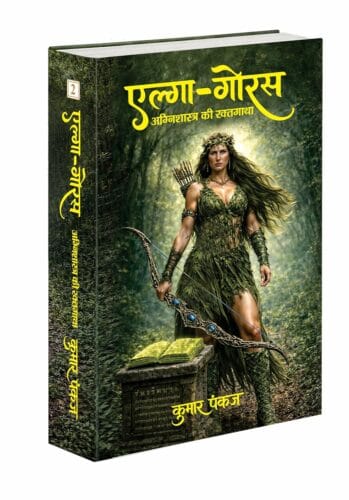
Kumar Pankaj presents an interesting case in contemporary Hindi literature because he appears to be attempting something that relatively few Hindi novelists have seriously pursued in recent decades. While many contemporary writers have chosen realism, memoir, social commentary, relationship-centred fiction, or historical narratives as their primary modes of expression, Pankaj has invested a considerable amount of creative energy into constructing a large-scale imaginative universe through Elga Gorus. Looking at the two volumes together, and considering the response they have generated among readers on platforms such as Goodreads and Amazon, one begins to see an author whose primary strength may not simply be storytelling but literary vision.
The first thing that stands out about Kumar Pankaj is his refusal to think small. Many writers begin with a plot and gradually build a world around it. In Elga Gorus, the process appears to be reversed. One gets the impression that the author first imagined an entire mythology, complete with forgotten histories, mysterious races, ancient texts, hidden realms, strange creatures, symbolic journeys, and secret knowledge systems, and only then began constructing a narrative within that universe. This distinction is important because it reveals the nature of his creative impulse. He is not merely interested in telling readers what happens next. He is interested in creating a world that feels larger than the story being told. This quality is visible throughout both volumes and is repeatedly highlighted in reader responses as well as independent reviews of the work.
In many ways, Kumar Pankaj seems closer to a myth-maker than a conventional novelist. The mythology of Elga Gorus is not presented as decorative fantasy. It forms the foundation upon which the entire narrative rests. The mysterious sacred text, the forgotten scripts, the unusual beings, and the hidden histories all contribute to a sense that readers are entering a pre-existing universe rather than watching a story being invented in real time. This is a difficult illusion to create. Fantasy writers around the world often spend years attempting to make their fictional worlds feel lived-in and authentic. Pankaj’s achievement lies in his ability to generate that feeling within the framework of Hindi literature, a space where large-scale fantasy world-building remains relatively uncommon.
His writing style is equally revealing. What immediately becomes apparent while reading Elga Gorus is his preference for visual storytelling. Many authors build scenes through dialogue or internal reflection. Kumar Pankaj often builds scenes through imagery. Readers repeatedly mention the visual richness of the novel, and independent reviews have highlighted the almost cinematic nature of many sequences. His landscapes are rarely passive backgrounds. They participate in the storytelling. Ancient caves, mysterious settlements, deserts, forgotten territories, and strange habitats are described with enough detail to create vivid mental pictures without overwhelming the narrative. This visual instinct suggests a writer who thinks in images as much as in words.
Another quality worth noting is his commitment to mystery as a narrative engine. Many novelists depend on emotional conflict, romance, social tension, or ideological debate to sustain reader interest. Kumar Pankaj relies heavily on curiosity. He understands that readers will continue turning pages if they feel that a larger secret lies beyond the immediate narrative. Throughout Elga Gorus, questions are often more important than answers. Why does a particular creature exist? What happened in the forgotten past? What is hidden within a sacred text? What lies beyond a certain place or prophecy? This technique creates a reading experience driven by discovery. It also explains why many readers describe the books as difficult to put down once they have entered the story’s world.
What perhaps distinguishes Kumar Pankaj most clearly from many contemporary Hindi writers is his willingness to trust the reader’s imagination. Modern fiction frequently feels compelled to explain everything. Characters explain their motivations. Narratives explain their symbolism. Authors often guide readers carefully toward predetermined conclusions. Pankaj takes a different approach. He leaves room for mystery, interpretation, and speculation. The world of Elga Gorus often feels larger than what is explicitly revealed on the page. This technique can be risky because some readers prefer complete clarity. Yet it is also one of the reasons the novels have generated enthusiastic responses among readers looking for something different from conventional storytelling.
The response from the reading community is itself revealing. Goodreads listings for both volumes show unusually strong ratings, with both major volumes maintaining ratings above 4.6 and generating a significant number of reader reviews relative to their recent publication. The books also appear to have become the author’s most visible and discussed works on the platform. While ratings alone never determine literary merit, they do indicate reader engagement. Research into Goodreads behaviour has repeatedly shown that sustained reader interaction often reflects deeper levels of audience investment than simple sales figures. In the case of Elga Gorus, the response suggests that the novels have successfully identified and activated a readership that has long been underserved within Hindi literature.
This may ultimately be Kumar Pankaj’s most significant contribution. For years, younger Indian readers interested in fantasy, speculative fiction, dark mythology, and immersive world-building have largely turned to English-language literature. Global fantasy franchises have shaped the expectations of an entire generation. Many readers came to assume that large-scale imaginative fiction was something available primarily in English. Elga Gorus challenges that assumption. Whether one considers it a complete success or a work-in-progress, it undeniably demonstrates that Hindi can sustain ambitious fantasy narratives. In doing so, Pankaj may be opening a door for other writers. Literary traditions evolve when somebody proves that a neglected possibility can work.
At the same time, a balanced assessment requires acknowledging certain limitations. Kumar Pankaj’s strengths are often inseparable from his weaknesses. His imagination is expansive, but such expansiveness can occasionally create density. The large number of characters, locations, myths, and narrative threads demands concentration from readers. Some may find the world-building more compelling than individual emotional arcs. Others may feel that certain sections prioritise atmosphere and mystery over narrative economy. Readers accustomed to minimalist fiction may find the scale intimidating. Yet these observations stem largely from ambition rather than deficiency. The challenges of Elga Gorus arise because the author is attempting something unusually large within the context of contemporary Hindi fiction.
Another aspect worth appreciating is the courage behind the project. Literary culture often rewards familiarity. Publishers, readers, and markets frequently prefer established formulas because they appear safer. Writing a two-volume fantasy saga filled with original mythology, unusual creatures, invented histories, and elaborate mysteries is a considerable gamble. The fact that Kumar Pankaj pursued such a project despite these challenges says something important about his creative priorities. He appears less interested in following trends than in building something distinctive. Whether every reader embraces the result is ultimately secondary to the significance of the attempt itself.
Looking ahead, Kumar Pankaj’s prospects within contemporary Hindi literature appear promising. Much will depend on what he does next. If Elga Gorus remains an isolated achievement, it will still be remembered as an unusual and ambitious experiment. However, if he continues exploring large-scale imaginative fiction, refines his narrative techniques, and further develops his already impressive world-building abilities, he could emerge as one of the more influential voices in modern Hindi speculative literature. The enthusiasm surrounding Elga Gorus suggests that an audience exists. The challenge now is sustainability.
In the final analysis, Kumar Pankaj appears to be an author driven by vision rather than convention. His greatest strength is not elegant prose, intricate psychology, or social realism, though elements of these are present. His greatest strength is the ability to imagine on a scale that contemporary Hindi literature does not often attempt. He writes as someone fascinated by myth, mystery, hidden histories, and the limitless possibilities of imagination. The response to Elga Gorus suggests that many readers have been waiting for precisely this kind of literary adventure. Whether one views him as a fantasy novelist, a myth-maker, or a literary risk-taker, Kumar Pankaj has already accomplished something noteworthy. He has reminded Hindi readers that imagination remains one of literature’s most powerful resources, and that there are still unexplored worlds waiting to be created.
Analysis by Abhinandan for The Indian Authors
..