I bet you must have heard, read or hummed this at some point in your life:
वर दे, वीणावादिनि वर दे!
प्रिय स्वतंत्र-रव अमृत-मंत्र नव
भारत में भर दे!
काट अंध-उर के बंधन-स्तर
बहा जननि, ज्योतिर्मय निर्झर;
कलुष-भेद-तम हर प्रकाश भर
जगमग जग कर दे!
नव गति, नव लय, ताल-छंद नव
नवल कंठ, नव जलद-मन्द्ररव;
नव नभ के नव विहग-वृंद को
नव पर, नव स्वर दे!
वर दे, वीणावादिनि वर दे।
Yes, the famous Sarasvati Vandana that we have all grown up chanting during our prayers in schools has been written by the Mahapran of Indian Hindi poetry – Suryakant Tripathi Nirala!
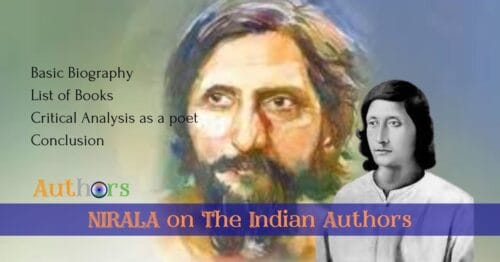
Among the architects of modern Hindi literature, few names command as much reverence as Suryakant Tripathi Nirala. A poet of rebellion, sensitivity, experimentation, and profound humanism, Nirala transformed Hindi poetry from rigid formalism into a living and pulsating artistic expression. His literary personality was at once romantic and revolutionary, lyrical and philosophical, deeply rooted in Indian tradition yet startlingly modern in sensibility. To study Nirala is not merely to study a poet; it is to encounter an entire phase of Hindi literary awakening in twentieth-century India. To further elevate the experience of studying and reading Nirala, this critical biographical article on Dinbandhu focuses on essential details of the poet’s life, his poetry style, philosophy and vision, and also on critics’ opinions on him and his works. Anyone who wants to study Nirala’s poetry will find this article helpful.
Nirala occupies a unique position in Hindi literature because he resisted confinement within any singular literary ideology. Though he is counted among the four principal pillars of the Chhayavad movement alongside Jaishankar Prasad, Mahadevi Varma, and Sumitranandan Pant, his poetry frequently transcended the aesthetic romanticism often singularly associated with Chhayavad. His literary journey reveals an artist deeply engaged with social injustice, personal suffering, philosophical inquiry, and linguistic innovation. Critics have often called him “Mahapran,” a title suggesting immense spiritual and creative vitality. The title is appropriate because Nirala infused Hindi poetry with a new life force, challenging conventions and, in a way, liberating poetic expression from the shackles of rigidity and norms.
Biographical Details
Born on 21 February 1896 (some believe 1899) in Midnapore, Bengal Presidency, Nirala’s original name was Suraj Kumar Tiwari. His early life was marked by immense hardship and instability. He lost his mother in childhood, and later several personal tragedies deeply scarred his emotional life. His upbringing in Bengal exposed him to Bengali literature and culture, particularly the works of Rabindranath Tagore, whose literary influence left an enduring impression on the young writer. Yet Nirala did not merely imitate Bengali literary culture. Instead, he absorbed its emotional richness and combined it with his own fierce individuality to create something distinctly original in Hindi. Such an amalgamation and a constructive use of the diversity of linguistic backgrounds and literary heritage rarely occur in the broad landscape of Indian literature. Nirala’s success exhibits his dexterity in absorbing, observing and using the same in terms of his readership, influence and productivity.
An interesting aspect of Nirala’s life is that Hindi was not initially his strongest literary language. It was after his marriage to Manohara Devi that he began seriously studying Hindi literature and grammar. His wife’s familiarity with devotional literature, especially Ramcharitmanas, played an important role in awakening his literary consciousness. This personal transformation later became foundational to his poetic identity. (And rightly so, therefore, Nirala used to credit his wife while writing the introductions to many of his published works of poetry.) He gradually shifted from Bengali literary influences to a powerful command over Hindi, eventually becoming one of its greatest innovators. Though the roles of his wife, the works he read and his determination to master the language may not be understated, there is one more aspect to the rise of Nirala’s poetic prowess.
The personal tragedies in Nirala’s life profoundly shaped his literary temperament. His wife died at a young age during the influenza epidemic of 1918, and the death of his daughter Saroj left him emotionally devastated. Poverty, loneliness, and social neglect haunted him for much of his life. However, unlike writers who retreat into despair, Nirala transformed suffering into artistic power. His poetry carries the weight of lived experience. The grief in his verses never appears artificial or decorative; it emerges from genuine human agony. This authenticity is one of the reasons why his poetry continues to move readers even today.
Nirala’s Contribution to Hindi Poetry:
Nirala’s contribution to Hindi poetry is revolutionary primarily because he broke away from rigid poetic conventions. Before him, much of Hindi poetry remained heavily dependent upon traditional metres and ornamental language. Nirala introduced free verse into Hindi poetry and demonstrated that poetic beauty did not necessarily require strict adherence to rhyme schemes and fixed structures. This innovation was initially criticised by conservative literary circles, but eventually it transformed the entire trajectory of Hindi poetry. He proved that emotional intensity and rhythmic fluidity could coexist without conventional metre. Such a movement, as marked by the poetry of figures like T S Eliot, was in popular trend in the early decades of the 20th century. However, more than a revolution in the form and structure of poetry, there are many things that Nirala contributed to the rise of Hindi poetry.
Nirala’s influence on later Hindi poetry is immeasurable. Subsequent generations of poets inherited from him the courage to experiment with language, form, and subject matter. The emergence of free verse and socially conscious modern Hindi poetry owes a significant debt to his innovations. Poets and critics alike continue to regard him as a foundational figure in the evolution of modern Hindi literature.
There is also something deeply contemporary about Nirala. His struggles with alienation, poverty, institutional neglect, and emotional trauma resonate strongly even in the present age. Young readers frequently discover in Nirala not merely a historical literary figure but a profoundly human voice wrestling with loneliness, injustice, and the search for meaning. His works remind readers that great literature emerges not from comfort but from intense engagement with life.
The style of Nirala’s Writing:
To discuss the qualities that he brought to the genre, Nirala’s poetic universe is extraordinarily diverse. Nature occupies a central place in his poetry, but unlike many romantic poets who merely celebrate natural beauty, Nirala often imbues nature with philosophical and emotional depth. In poems such as Juhi Ki Kali and Sandhya Sundari, nature becomes sensuous, mystical, and emotionally alive. The imagery is delicate yet charged with symbolic meaning. His romanticism is never passive; it constantly interacts with existential and spiritual questions. Nature, in the hands of Nirala, becomes far more than merely a green vessel to embody the romantic notions or represent the calm or chaos of the heart.
At the same time, Nirala was deeply conscious of social inequalities. His compassion for the oppressed classes distinguished him from many contemporary poets. He wrote about labourers, peasants, lower castes, and the marginalised with rare sincerity. His prose work Chaturi Chamar is frequently cited as an important example of socially engaged Hindi literature because it foregrounds caste realities with unusual boldness for its time. Similarly, Kulli Bhat explores human identity and social prejudice in a manner that reveals Nirala’s progressive outlook.
Among Nirala’s poetic masterpieces, Ram Ki Shakti Puja occupies a legendary status. The poem reimagines the figure of Lord Rama at a moment of spiritual and emotional crisis before his battle with Ravana. Rather than presenting Rama merely as a divine hero, Nirala portrays him as a deeply human figure confronting doubt and vulnerability. The poem combines mythological grandeur with psychological realism and philosophical introspection. Its language is elevated yet emotionally accessible, and its rhythmic energy remains astonishing. Many scholars consider it one of the finest long poems in Hindi literature, especially in Veera and Raudra Rasa.
Another monumental work is Saroj Smriti, an elegy written after the death of his daughter Saroj. This poem stands among the greatest expressions of paternal grief in Indian literature. Nirala’s sorrow in the poem is intimate and restrained, avoiding sentimental excess while achieving immense emotional power. Through personal mourning, he reaches universal human emotions, making the poem timeless in appeal. For many critics and readers of Hindi poetry, Saroj Smriti remains one of the finest elegiac compositions.
His long poem Tulsidas is equally significant because it reflects Nirala’s engagement with India’s spiritual and literary traditions. Rather than merely glorifying the medieval saint-poet Tulsidas, Nirala attempts to understand the inner psychological and philosophical struggles of the poet. The work reflects Nirala’s belief that powerful literature emerges from deep spiritual and moral conflict rather than from a joyful experience of the ordinary type.
Nirala’s language deserves particular attention from literary critics. He possessed extraordinary linguistic flexibility and enriched Hindi poetry with a new expressive range. His diction could shift from Sanskritic grandeur to conversational simplicity depending on thematic requirements. This linguistic versatility helped modernise Hindi poetic language. His experiments expanded the possibilities of poetic expression for future generations.
The influence of Bengali literature, Sanskrit traditions, Bhakti poetry, and Vedantic philosophy can all be traced in Nirala’s works. Yet he synthesised these influences into a distinctly original voice. His poetry frequently reflects Advaita philosophy, where the boundaries between self, nature, and the divine become fluid. However, his spirituality never becomes detached from social realities. Unlike purely mystical poets, Nirala remained deeply aware of human suffering and injustice.
One of the remarkable aspects of Nirala’s literary career is his transition from romanticism to social realism without losing poetic intensity. Early Chhayavadi elements gradually gave way to sharper social concerns. This evolution demonstrates his refusal to remain confined within literary movements. He continuously reinvented himself as a writer. Such creative restlessness is a hallmark of major literary figures.
Nirala: The Prose Writer:
Nirala’s prose writings deserve equal attention. Although widely celebrated as a poet, he was also an accomplished novelist, essayist, translator, and critic. His novels frequently reveal psychological depth and social concern. Unlike purely escapist fiction, Nirala’s prose interrogates social structures and human behaviour. His essays exhibit intellectual sharpness and a fearless critical spirit. He was never afraid to challenge literary orthodoxy or social hypocrisy.
A detailed look at Nirala’s notable published works reveals the astonishing breadth of his literary output.
Major Poetry Collections
- Anamika (1923)
- Parimal (1930)
- Geetika (1936)
- Anamika II (1939)
- Tulsidas (1939)
- Kukkurmutta (1942)
- Anima (1943)
- Bela (1946)
- Naye Patte (1946)
- Apara (1946)
- Archana (1950)
- Aradhana (1953)
- Geet Kunj (1954)
- Sandhya Kakli (posthumously published in 1969)
Major Novels
- Apsara
- Alka
- Prabhavati
- Kulli Bhat
- Nirupama
- Choti Ki Pakad
- Kale Karaname
Significant Prose and Other Writings
- Chaturi Chamar
- Ravindra Kavita Kanan
- Essays on literature, society, and aesthetics
- Translations and critical prose works
Want to read Nirala? Click the link below to find all his books on one page on Amazon India –
Buy Poetry, Novels, and Prose works by Nirala – click here.
This range demonstrates that Nirala was not confined to poetry alone. His literary imagination extended into fiction, criticism, translation, and reflective prose.
Critics on Nirala – A Brief Overview:
Critics have responded to Nirala with immense admiration, though not without debate. The noted critic Ram Vilas Sharma devoted substantial scholarly attention to Nirala’s oeuvre. Sharma regarded works such as Ram Ki Shakti Puja, Saroj Smriti, and Parimal as masterpieces of Hindi literary creativity. His multi-volume critical study Nirala Ki Sahitya Sadhana remains one of the most influential academic engagements with Nirala’s writings.
David Rubin, one of the major translators of Hindi poetry into English, played an important role in introducing Nirala to international readers. Rubin viewed Nirala as a revolutionary figure who revitalised Hindi poetry through innovation and emotional authenticity. His translations helped global audiences appreciate the complexity and beauty of Nirala’s works, accessible otherwise only to native readers of Hindi literature.
Noted critic Doodhnath Singh approached Nirala from a psychological and existential perspective in Nirala: Aatmahanta Astha. Singh interpreted Nirala’s life as a struggle between creative idealism and harsh social realities. Such interpretations highlight the tragic dimensions of Nirala’s personality while also emphasising his spiritual resilience.
Many modern scholars have also noted Nirala’s progressive social consciousness. His concern for the downtrodden and his critique of social hierarchies anticipate later progressive literary movements in Hindi. Though associated with Chhayavad, Nirala cannot be reduced merely to romanticism. His writings often possess radical democratic impulses and a deep ethical engagement with society.
It is very interesting to observe that when accomplished readers bestowed with the prowess of critical observation construe the growth of Nirala as a poet, a very distinct pattern emerges. Nirala’s social engagement gradually overtook his romantic and nature concerns. However, his spiritual journey remained there and got more refined with time. The more he wrote, the more mature he became and the more vivid his themes became, the spiritual yearning and longing for the divine blessing, which strangely remained a search throughout his life, became more and more intense.
Nirala: The Enigma of Hindi Literature
His personality itself became legendary in Hindi literary culture. Nirala lived almost like a wandering ascetic intellectual. Financial instability, unconventional behaviour, and emotional turbulence surrounded his life. Yet these very qualities contributed to his mythic literary stature. He embodied the image of the suffering artist who remains uncompromising in pursuit of artistic truth. Many anecdotes about Nirala emphasise his generosity, eccentricity, and indifference towards material comforts. He often lived in extreme poverty, yet his creative dignity remained intact.
Despite immense literary contributions, Nirala’s life remained materially difficult. He rarely enjoyed financial stability or social recognition during his lifetime. Yet his commitment to literature never weakened. This contrast between artistic greatness and worldly suffering contributes to his enduring legend. He remains a symbol of uncompromising literary dedication.
To read Nirala today is to encounter a writer who refused to separate beauty from truth. His poetry possesses lyrical elegance, but it also carries ethical seriousness. His romantic imagination coexists with social consciousness; his spiritual vision coexists with human suffering. Such synthesis makes him one of the most complete literary personalities in Indian literature.
Nirala: Beyond the World of Words:
In conclusion, Suryakant Tripathi Nirala stands as one of the most transformative figures in modern Indian literary history. He revolutionised Hindi poetry through free verse, expanded its thematic horizons, and infused it with unprecedented emotional and philosophical intensity. His works continue to inspire readers because they embody both artistic beauty and moral courage. Whether in the sublime grief of Saroj Smriti, the epic power of Ram Ki Shakti Puja, or the social realism of Kulli Bhat, Nirala consistently demonstrated extraordinary creative depth.
More importantly, Nirala represents the restless conscience of Indian literature. He challenged conventions, confronted injustice, embraced experimentation, and transformed personal suffering into universal art. His literary legacy is not confined to textbooks or academic discussions; it continues to live in the emotional and intellectual imagination of readers across generations. In an age increasingly dominated by superficial expression, Nirala’s works remind us that literature can still be fearless, compassionate, spiritually profound, and intensely human.
You can read Nirala by getting his books from Amazon India. Click the link below to get your copies now.
Buy the works by Nirala from Amazon – click here.
Dr Alok Mishra for The Indian Authors
Poet and Literary Critic
Teaching English Literature at Nava Nalanda Mahavihara, Nalanda